
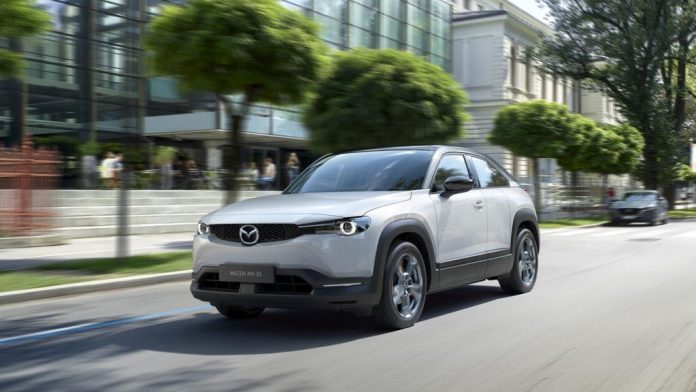
Mazda this week will reveal a version of its MX-30 electric vehicle with a rotary engine in addition to its electric propulsion system. The company confirmed that the model is coming with a simple logo sent to journalists. The move is a bit opaque, so it requires some explanation.
The MX-30
Mazda sells just one electric car in the U.S., and it’s a puzzling one. The 2023 Mazda MX-30 is a stylish subcompact SUV with hidden rear doors and a coupe-like roof profile that looks great under a two-tone paint job. It boasts a minimalist, modern interior with cool wool-look inserts set into dove gray leather seats and unique materials like sustainable cork trim in the center console.
But it’s a sleepy performer by Mazda standards. Worse, it has a range of just 100 miles – the lowest range of any EV for sale in the U.S. today.
The MX-30 is sold only in California and hasn’t sold well, given its obvious limitations. It starts at $33,740 and does not qualify for the federal $7,500 tax credit for electric cars.
However, Mazda has promised in the past that a plug-in hybrid (PHEV) version was coming. A spokesperson told us last year that the model would arrive for the 2023 model year and more information would be available closer to launch.
The Rotary Engine
The engines Mazda sells in the U.S. today all function, more or less, like other automakers’ engines. But the brand has a history with a radically different powerplant.
Most engines place their cylinders in a straight line, or a pair of straight lines often set at a 45-degree angle to one another. That layout inspires engine nomenclature. An inline 4-cylinder engine has four cylinders in a line. A V6 has six – two rows of three, set in a V-shape. Each has a separate piston to drive the combustion process.
Mazda historically used a design called a Wankel engine (named after its inventor), which uses an almost-triangular rotor instead of traditional pistons to control combustion. Rotary engines are known for smooth power output and a lot of power in a small package. But they can be fuel-inefficient at larger sizes and produce a lot of heat compared to other designs. That can leave them needing oil more frequently than traditional designs.
The Logo
What Mazda sent journalists today was a logo shaped like a Wankel engine’s rotor with an “e” inset into it. Alongside the logo, text says Mazda will use this week’s Brussels Motor Show in Belgium to debut a new version of the MX-30, a “compact crossover will feature an electric generator powered by a newly-developed rotary engine.”
Why a rotary engine rather than a more traditional 4-cylinder? Probably because rotary engines can produce so much power for their weight – allowing Mazda to place a very small engine in the MX-30 and generate a lot of power with it.
The term “generator” likely signals that the engine won’t directly power the wheels – just recharge the battery as you go. That means power output is likely the same 147 horsepower as the all-electric MX-30. But the range will be effectively infinite as long as owners have access to gasoline.
So the MX-30 may not get zippier. But the rotary generator will solve its range problem, making it a more attractive proposition provided the price stays reasonable.
